
By Juan José Pujana Mena
For decades, talking about a metro in Bogotá was almost a joke. Every generation had its own announcement, its own study, its own plan that ended up in a drawer. That is why it feels strange, and even moving, to drive along Avenida Caracas today and see the viaduct there, concrete and steel, with red trains running tests on top.
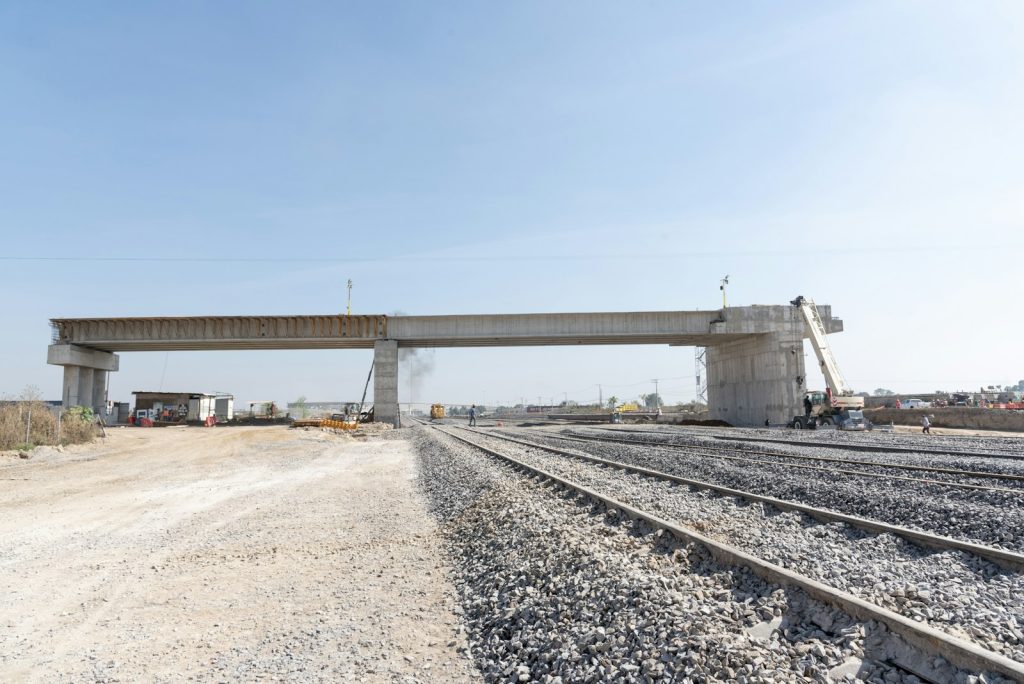
According to the city’s latest report, at the end of August 2026 Line 1 was 82.33% complete. Seventeen kilometres of viaduct are finished out of nearly 24, the first tests with two trains running at the same time have taken place, and a 215-metre railway bridge over Caracas and Calle 26 is done. There is still work to do, but the metro is no longer a promise. It is a construction site.
A metro is not just a train
Public debate has rightly focused on engineering and politics: elevated or underground, who started it, how much it costs, when it opens. A conversation that has happened far less is, for me, the most important one: what will happen in the blocks around each station?
A metro transforms a city when people can live, work, study and shop near it. A station surrounded by closed warehouses, car parks and broken pavements moves people, but it doesn’t build a city. A station surrounded by homes, ground-floor shops, trees and good pavements becomes a small neighbourhood centre.
The housing opportunity, and its risk
As a housing developer, I can’t help thinking about this in concrete terms. Around every station there are under-used plots, old houses and warehouses left in the middle of the city. There is a huge opportunity to build well-located homes of different sizes and prices for people who today spend two or three hours a day commuting.
But that opportunity has two faces. Without good planning, land around the stations will become expensive, only one market segment will be served, and the people who live there now may be pushed out just as the metro finally arrives. It would be a sad irony to wait fifty years for a train and then be unable to afford living near it.
The pavement is infrastructure too
Most people will reach the metro on foot. Ten, fifteen, twenty minutes of walking. The quality of pavements, lighting, safe crossings and street trees will decide whether people use the metro gladly or only because they have to. The works around the stations deserve as much attention as the viaduct.
Bogotá already has the train. Now it needs to build the city that deserves it.
Juan José Pujana Mena is a housing developer based in Bogotá, Colombia. More about him.